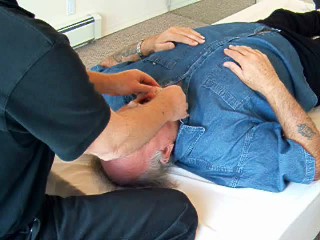
Freeing Tight Psoas Muscles | The Well-Tempered Psoas | The Inner Psoas

As it happens, it isn’t exactly rocket science to understand why the psoas muscles get tight. The answer is, "insults and injuries". When we get uptight, we get tight. 

To free psoas muscles, see the end of this piece.

            Insults and injuries form memory patterns.  We never completely forget.  Insults and injuries leave their mark in memory.

                The memory patterns aren't just psychological; they are psycho-physical. Muscular tensions are involved. The term, "uptight" is literal.  The memory of painful experiences is not just "inner" and "emotional", different from the body, but present as the felt state of the body:  patterns of tension and other stress-induced changes -- the physical sensations of the memory, carried all the way through to the core and experienced to a greater or lesser degree as physical changes that affect not just how we feel, but also how we move.

            The psoas muscles are involved because they are constantly involved in movement and in balance. When they tighten, our movements and balance change -- and, as core muscles, they're involved with all other muscles and muscle groups to different degrees.

            For that reason, single-muscle releases of the psoas muscles miss a lot of the tension pattern of which tight psoas muscles are a part.

           (For the clinicians out there, the tension is part of a larger pattern of psychomotor/ neuromuscular tension activated by stress and maintained as an activated memory pattern, and that kind of tension involves the body-core.)


            There’s more.

            In "An Essential Understanding of the Psoas Muscles", I use the term, “open core”.  I refer to a person’s “full stature”.  I talk about the nervous system’s centralized role in regulating muscular tension in arising from rest to sitting, standing, and walking; for each of those movements, a corresponding state of mind exists.  I’ll go into that shortly; as you’ll see, it’s pretty obvious, when pointed out.

MEMORY

Click to get started, for free with
Free Your Psoas self-renovation program
       Chronically tight psoas muscles indicate the existence of stuck movement-memory patterns. To free tight psoas muscles, we must release the trigger of the tension -- whether the memory of activity (movement), of a sensation (injury), or of emotional insult.

First, we release; then, we must integrate the movements of our psoas muscles into better coordination into the entire muscular system. That requirement also gets missed in common therapies -- which is one reason they work only as well as they do.

RELEASE

          "Release" doesn't necessarily mean catharsis. It means getting unstuck. Catharsis is the explosive uncorking of pent-up emotion when we release resistance to doing so suddenly.  Better, to regulate the resistance and the emotion, together, and do the releasing gracefully and essentially comfortably.

           A person stuck in a habit pattern is enclosed in the habit and to that degree, closed to new experience. There’s no space. All there is, is the repetitive replay of memory. Noise. The closed (or hard-) core condition.

           A deliberate, new action can modify a habit – but only if that new action first softens up the habit. Otherwise, the habit prevents change past a certain stage. That's another reason why common therapies work only as well as they do.

           The key to softening up a habit is to recover the intention that created it.

           One way to recover the intention that created it is to do, deliberately, what the habit does automatically until you can feel yourself doing it, rather than it happening to you.

            The saying is, "Whatever you are doing wrong, do it more, and then less. That action (done enough) melts the mold of a habit so that it can be remolded.

To hear his experience, click above.

            In that state of “melt”, you no longer feel trapped in (and by) that habit. Now, there's the space for change.

            So, to free tight psoas muscles, deliberately to do the movement actions of the tight psoas pattern (which involves many muscles and movement elements), and add energy to them.  When we do that, we feel those muscles "give in" and relax, as we relax.

            Of course, you need to know what that tight psoas muscle pattern is.

            Step-by-step instruction in a program such as Free Your Psoas, guides you into and through the tension/movement pattern, as it exists throughout the entire muscular system -- overcoming one of the shortcomings of common therapy.

HOW THE PSOAS MUSCLES ACT IN REST AND ACTIVITY

            The different states of activity are common states of mind.

    * REST/REPOSE:  no intention, unreadiness for action, no engagement with experience
Although sleep may seem the very definition of rest, sleep is no necessarily restful.  Ask anyone with insomnia.  Dream sleep involves emotional, mental, and subtle physical activity (e.g., REM -- Rapid Eye Movement sleep).  Deep, dreamless sleep is as close as most of us come, and generally, tense people stay tense even during sleep.  Waking repose is generally not full rest.
    * SITTING:  coming to some higher degree of activity; mental and emotional engagement

    * STANDING:  coming to a still higher level of activity; active mental, emotional and physical engagement

    * WALKING etc.:  coming to a still higher level of activity and engagement

            Any “hold” in any of these states is a limit on the responsiveness of the psoas/iliopsoas muscles, generally at some level of contraction that you can't affect by ordinary efforts.

  • If the psoas muscles are simply non-functional, they express a pattern of immaturity in which the person is either passive, relatively receptive like a child, without initiative, or without the capacity to formulate a deliberate intention and more concerned with outer appearances than with true intentions.  It's an arrested (ar-"rested") state of development.

  • If the psoas muscles are equally tight, left and right, but very tight, they express the stuck pattern of sitting and the mood of sitting -- limited action and actually a restraint upon standing up for action (taking a stand).  It's an arrested state of starting things.

  • If the psoas muscles are equally tight, but free enough to permit standing up without pain, they express a pattern of self-restriction (repressed action).

    In this state, we see and feel an arched spine.  The spinal muscles, which tighten as arousal level increases, arch the spine backward; the psoas muscles pull the top of the pelvis and lumbar spine forward, and contribute to the arching.  The person exists in a state of co-contraction, which involves low grade low back pain from back muscle fatigue.

  • If the psoas muscles are asymmetrically tight, they usually express a stuck pattern of action, as if stopped mid-step in a walking action.  It's an arrested state of follow-through and often the state of a prior leg or foot injury that triggered a cringe response and changed the walking pattern.

    Alternately, there may have been a hard fall or other pelvic injury that knocked the sacrum (central pelvic bone, in back) off center and triggered a psoas muscle response, in which the psoas is incorrectly identified as the center of the problem.

  • All cases of chronically tight psoas muscles prevent the ability to come to complete rest.
Both physical and emotional trauma can create a memory impression sufficiently gripping to create chronic muscular tensions of this type.

These memory impressions function as if the situation is still happening in present time – with the attendant emotional flavor and arousal state.

As I said in the other article, as a generality, people never experience deep rest; they/we are stuck at some level of activity, some level of tension, stuck in some pattern of memory, of arousal, of reactivity, of resistance to outer things and to things inside ourselves.

As the psoas muscles are involved in every state of arousal from rest to full activity, a person stuck at some state of activity has psoas muscles (and actually, the entire musculature, to some degree) stuck at some level of activity. This statement is, of course, an oversimplification, but as a generalization, it holds good.

To the degree that we are stuck in a memory at the physical level (memory of repetitive action, memory of injury), at the emotional level (memory of experience, memory of insult), or at the mental level (memory of worldview, memory of limitation), we are stuck in a closed/hard-core condition, unavailable to new information, new experience, change.

In general, we are held in a pattern and prevented from coming to our full stature, our best balance, our self-assurance, our freedom.

That means that psoas muscles don’t lengthen freely when coming from sitting to standing. We never get completely out of the crouch; we never elongate fully unless we apply extra effort (generally as an automatic action). We never come to our full stature.

And we are always held in a pattern. It’s just that the pattern may be long-term dysfunctional or short-term functional.

If it’s long-term dysfunctional, we are responding out of habit, maintaining our pattern with a sense of friction against some outer experience or in a state of conflict with our inner experience or preference, in a kind of chronic state of emergency.  

If it’s a short-term functional pattern, it's emerging and changing in the moment, playing out freely as a stream of experiences:  sensations, emotions, ideas arising without an effort to prevent or force them, a creative stream of new emergence by which we may bring something new (not memory-based or conforming to an existing memory mold). Psoas muscle tension in this case is, generally, subconscious, but can be felt from manual pressure on the psoas muscles or tendons.

IN THE ABSTRACT

In the abstract, an awakening or filling out of somatic awareness involves recognizing when we are stuck in stress-patterns (memories) and then progressively melting the mold of memory.

The mold of memory keeps us in patterns of tension, formed some time ago.  To melt the mold of memory permits us to continue to dissolve, and evolve, to reshape all the way through to the core.

As “melt” progresses (as in somatic education techniques), we elongate and straighten into looser movement and a more comfortable balance.  By melting, we surrender both to staying the same and changing. We let ourselves stay the same, and also let ourselves change -- the psychological dimension of physical changes.

Without that “melt”, attempts to free the psoas muscles and the core are limited.

AND CONCRETELY

Clinical Somatic education is a good place to start.  Here's where I present practical means for freeing tight psoas muscles

Put yourself together, better.  Know distinctly the difference between getting better and getting such small improvements that you have to take it on faith that improvements are happening.

The self-relief program linked below guides you through the process.

~~~~~~~~~~~~~
Lawrence Gold is a certified Hanna somatic educator providing lasting relief for a range of pain conditions, including tight psoas muscles. He offers a money-back guarantee. Contact him at https://somatics.com/wordpress/contact.

Get started for free with the
Free Your Psoas self-renovation program

https://somatics.convertri.com/psoas-2017-6-13


CLICK TO PREVIEW


EMERGENCY BACK SELF-CARE | FIRST AID FOR BACK PAIN | SOMATICS.COM

If you have back pain, then the first thing to consider is that you don't "have" back pain; back pain "has you" in its grip. That way of describing it would seem to be more true to your experience, wouldn't it? This video, below, shows how you can get control of the back pain that has you in its grip and then get rid of it, while recovering the comfortable and secure use of your back.

Although some people believe that standard procedures are "time-tested" and inherently more reliable, in this case, the opposite is true. Faster, more complete, and longer-lasting relief can be obtained with a less invasive, "high-touch" procedure that hits "the mark" than by standard procedures that miss "the mark". What is "the mark"? What to do, right now? 

This video shows what you can do to relieve your own back pain and restore freedom of movement. The procedure has helped thousands of people who have already had back surgery or other invasive procedures.


For a clear understanding of a new, more effective approach to back pain than stretching, strengthening, adjustments or massage, please see this page.

For chronic back pain, please see this page, which also contrasts conventional back pain methods (including spinal decompression devices) with an entirely new, more effective approach.


TMJ Syndrome/TMD/Bruxism Treatments

This entry is for you if you have bruxism, orofacial pain, earaches, TMJ headaches, or clench your teeth at night.

TMJ Syndrome | Clinical Somatic Education session

Oscar W. in Session for TMJ Dysfunction

Once again, I am drawn to address common practices used to alleviate common health conditions.  In this case, it's TMJ Dysfunction (or "TMD" or "TMJ Syndrome"), a condition that people commonly expect to take months or years to clear up, but which can be cleared up in weeks by oneself or faster with clinical somatic education sessions.


The Root of TMJ Dysfunction

Common dental practices overlook the root of the condition:  neuro-muscular conditioning caused by trauma (injury, previous dental work) or long-term emotional stress (particularly, anger).  "Neuro-muscular" means, muscles controlled by the brain. Another name for "neuro-muscular" is "muscle/movement memory" -- the state of tension we return to, automatically.

Even "neuromuscular dentistry" approaches the situation indirectly, by changing such things as a person's bite pattern, rather than changing muscular tension habits; the "neuromuscular" part exists in their minds, but not in their way of approaching the situation.

An article posted here gives the details.

Here are topics that give reasoning and details.
The common therapeutic means for addressing the condition address symptoms, rather than causes.

As a clinical somatic education practitioner, I've developed an effective and reliable self-relief program, which addresses exactly the underlying cause of TMJ Syndrome:  the reflexive muscular action in the muscles of biting a chewing that causes the complex array of symptoms associated with TMJ Syndrome.

INTRODUCTION TO THIS TMJ SELF-RELIEF PROGRAM


long version
TMJ Dysfunction (TMD) Corrected in Eighteen Minutes
with Hanna Somatic Education


MORE:
Free Preview of Self-Relief Program -- 5 Well-designed Somatic Exercises That You Can Use to Make Your Jaws Feel Better and Make Your Bite Better -- in about 2 Weeks

Instructions in Somatic Exercises to Free Your Own Jaws
Common Causes of TMJ Syndrome/TMD/Bruxism


YOUR STORY, MY STORY, EVERYONE'S STORY

We all respond similarly to injury: we tighten up (involuntarily cringe).

Stress (in life and relationships) and repetitive motions (e.g., in our occupation) have similar effects: we tighten or get tight so often or for so long that our brain -- the master-control organ of our muscular system -- learns to hold muscles tight indefinitely, automatically, habitually, and ultimately, beyond our ability to relax them.

For example, a car mechanic may develop back spasms or neck pain; a haircutter may develop wrist, hand or shoulder pain; a massage therapist may develop low back pain, and and wrist pain, or leg pain; someone with a stressful job or home life may develop headaches -- and of course, joint pain due to overcompression by tight muscles is common among the general population; they call it, "arthritis".

A person going through a life crisis may emerge with new tensions, restricted breathing, and low energy.

We forget how we used to be and get stuck in a strange new condition. The burn of muscle fatigue and stiffness become permanent. Inflammation, chronic fatigue, and joint degeneration commonly occur as long-term side-effects of that tension. Stress-related symptoms such as headaches or sciatica or other symptoms occur, seemingly inexplicably.

Not Aging, Genetics, or Mechanical Causes

Most often, when symptoms become chronic, people (and professionals) attribute the condition to aging, genetics, or mechanical causes -- erroneously.

Despite these symptoms, including pain, we may have no injury, in the sense of damaged flesh or bone. The damage may have healed, long ago; the life crisis may have passed, but we may remain stuck with the residue of injury and/or stress because of memory-caused tension or stress-reaction.

Because tight muscles cause pain and stiffness, because your brain controls your muscles, any therapy, to be effective, must address muscular activity at the brain (i.e., memory) level.

Clinical somatic education has advantages over drugs or therapy applied to soft tissue and joints: much less pain during therapy and faster improvement.

For most cases of chronic musculo-skeletal pain, methods that use the brained-based pandicular response, such as Hanna Somatic Education® and possibly, others, is sufficient as a stand-alone rehabilitation method.

Click:
TO MAIN SITE
TO INTERVIEW on Happiness-After-Midlife.com

On Back Pain Relief - referral link

This page is to enable people with back pain to help themselves, whether or not they have already sought professional help. In fact, it may render professional help unnecessary.

WHAT YOU CAN DO ABOUT YOUR OWN BACK PAIN | LIFTING INJURIES | SOMATIC EDUCATION (view on Google Sidewiki)

Hanna Somatic Education: Socratic, Promethean, Herculean

I realize, now, that the title of this piece might seem like hype. I thought Thomas Hanna's introduction to his methods sounded like hype. What pathos! when the truth sounds unbelievable! when what sounds too good to be true IS true!
~~~~~~~~~~~~~~~~~~~~~~~~~~~~~ 
CLICK:

~~~~~~~~~~~~~~~~~~~~~~~~~~~~~
Hanna somatic education is a modality used to lastingly eliminate chronic, non-malignant musculo-skeletal pain (such as back pain, sciatica, psoas muscle pain, or bursitis) and stress-related disorders (such as breathing difficulties or headaches).

It uses a natural response similar to yawning rapidly to free tight muscles, restore comfort, and improve movement. "Rapidly" means "over a short series of one-hour clinical session", and "short series" means around five sessions, average. This natural, whole-body response has a name: pandiculation, a funny sounding word that means, basically, "whole-body yawn".

To understand the metaphors, "Socratic, Promethian, and Herculean" in relation to Hanna Somatics, we must understand some things about Socrates, Prometheus, and Hercules.

The Socratic Method and View

CLICK:

Socrates was a teacher and prominent personage of ancient Greece. As a teacher, he guided his students along lines of consideration, asking them leading questions so that his students might arrive at insight, themselves. His viewpoint of knowledge, topsy turvy to that of most contemporary ways of operating, is that we inherently know everything, but have forgotten nearly everything, and the teacher only reminds us of what we have already known but forgotten.

Compare the Socratic view with the following conventional view of knowledge:
We fundamentally know nothing and have to learn everything, and the teacher is the one who tells us what's what. One who really knows what's what ends up in Who's Who, and if you're not in Who's Who, you're nobody.

Kind of opposites, aren't they?

The Socratic method is "from inside, out, prompted by what's coming in from outside." The methods of Hanna Somatic Education produce, to quote Thomas Hanna, "an internalized learning process" by guiding clients through learnings of certain kinds of movements and their sensations.

This is not the same as letting clients dictate the course of a session or do a poor approximation of our instructions or add irrelevant efforts to a movement; it's not the same as our taking whatever they give us as a response to our instructions.

Remember, they are amnesic and don't usually understand their condition correctly.

Socrates led his students to conclusions interactively, according to their responses; we lead our clients to outcomes interactively, according to their responses.
The instruction comes from outside; the learning comes from within.

Now, Promethian. 
CLICK:


Prometheus was the son of the Titan, lapetos, and the nymph, Klymene.

The name, "Prometheus," means "foresight."

According to myth, it was Prometheus who taught humankind the skills of civilization and gave us fire. (Crane, Gregory R. (ed.) The Perseus Project, http://www.perseus.tufts.edu, July, 2002).

The gifts of Prometheus were the technologies of civilization and a corresponding awakening of attention of a special kind in order to receive and use these gifts.

Somatics is exactly an awakening of attention of a special kind. It is an awakening of attention on many levels of the human being, bringing self-mastery.

The process teaches, in effect, that there is no relationship between mind "and" body (the "two" being internal and external manifestations of the same thing, and therefore not-two). It awakens us to new sensations, to direct experience of what was subconscious and running the show from beneath.

Somatic education cultivates the ability to focus attention, to act deliberately, to recognize the relationship between effort and its outcome, to be self-correcting, to follow through to completion. It teaches how to direct attention and intention toward the same thing. It gives us access to more of our abilities.

For almost everyone, these learnings generate a significant awakening. You can see how they are all elements of a sound civilization necessary to responsibly use the gifts of Prometheus.

My hope for my working and playing with people in the somatic realm, is that their "pilot light" gets lit (they receive the gift of fire), and they are able to continue somatic awakening largely on their own.

And now, Herculean. 
CLICK:


Hercules (Heracles), son of Hera, wife of Zeus, known primarily for his strength, has been described as the perfect embodiment of pathos, the experience of virtuous struggle against great difficulties that leads to fame and, in Hercules' case, immortality. (Crane, Gregory R(ed.) The Perseus Project, http://www.perseus.tufts.edu, July, 2002).

Ever try to get someone to do something in a new way? Ever have anyone ask for your advice and then argue with you about it or ignore it?

To do somatic education procedures with people, even to get them to test it for themselves, even when they are interested in doing them, often "gets interesting." It seems, at times, that a Herculean effort is needed to guide people through the process of change, even when they want to change.

Magnify that challenge to an entire culture accustomed to placing responsibility for health and well-being outside oneself, and you see the scope of our work.

To get a culture to change its way of operating from that of dependence upon a DoctorPatient/Parent-Child system (that saves people from the consequences of their own actions -- or doesn't) to that of responsibility for ones own well-being (reducing the need to be saved from consequences) is a Herculean Feat tantamount to cleaning King Augeas' stables by redirecting a river.

The feats of Hercules, of which cleaning King Augeas' stables was one of twelve, required strength and the use of available resources in new ways. They required more than Hercules' solitary strength, but also his acceptance of help and ideas from others, his persistence, and his ingenious development of new ways to overcome seemingly impossible challenges. In the case of King Augeas' stables, Hercules re-directed a river through them to clean them.

What might it be like to direct a river of attention through the Augean Stables of today's mass-mind?

What would it be like to feel the spirits of these historical and ancient figures, Socrates, Prometheus, and Hercules, in Somatic Education?

To try it and find out, identify with each of these figures and identify yourself as a Hanna Somatic Educator.

© 2002 Lawrence Gold


To see clinical somatic education in action,

For First Aid for Back Pain, click here.
For "back pain Q&A", click here.

Spinal Decompression Therapy and Back Pain

The mystique of technology as a fix for everything extends to back pain -- in particular, as spinal decompression therapy, an offering that has gained visibility as among the latest in spine care (along with laser treatment -- this article applies to that approach, too).

This article explains how the approach is intended to work and its limitations.

Variations of Spinal Decompression Therapy

Spinal Decompression Therapy involves a mechanical device intended to separate vertebrae and thereby to relieve pain.

This approach is a higher-technology variation on a simpler method, inversion therapy, which involves a kind of treatment table that, by anchoring the user's ankles and turning upside down, uses gravity to separate vertebrae.

Both methods are variations on traction, again, using mechanical force to separate vertebrae.

The premise of all three methods, spinal decompression therapy, inversion therapy, and traction, is that vertebrae are too close together and need separation.

That premise is good as far as it goes -- but let's look deeper. Why do vertebrae get too close together?

The Cause of Pain

Understand that vertebrae are linked together not only by discs and ligaments, but by muscles that control spinal alignment. When those muscles tighten, vertebral alignment changes; twists, curvature changes, and compression of neighboring vertebrae results. Muscles pull vertebrae closer together; the discs push the vertebrae apart.

Muscle tightness of this sort is supposed to be intermittent and temporary, as required by the demands of movement and lifting; muscles are supposed to relax (return to "zero" resting tone) when these demands end.

However, when, for reasons related to injury and stress, this tightness becomes habituated (i.e., quasi-permanent), problems (i.e., back pain) result: nerve root compression, bulging discs, facet joint irritation, and muscle fatigue (soreness) and spasm.

This habituation is a muscular behavior (postural reflex pattern) learned by and stored in the brain, the master control center for all muscles.

Learning is a matter of memory; when either prolonged nervous tension, repetitive movements, or violent injury occur, the memory of these events displaces the memory of free movement and habituation results; people forget what free movement feels like and forget how to move freely. They fall into the grip of the memory of tension.

Movement (Muscle) Memory

Muscles obey the nervous system, with all but the most primitive reflexes stored in the brain as learned action patterns that control all voluntary movement (vs. reflexive). There is no muscle memory other than what is stored in the brain; muscle memory is movement memory.

Knowing that, consider approaches that mechanically stretch muscles or pull vertebrae apart. What do they do to habituated muscular behavior? to the memory of tension?

The answer: they temporarily force muscular relaxation but do not restore the memory of normal tension and movement, which is acquired "learn-by-doing."

We are genetically designed to return to our familiar movement patterns once outside influences end; we return to our memory of how we have learned to move and hold ourselves. Shortly after the end of a therapy session, our familiar movement behavior and muscular tensions come back because you can't change learned reflex patterns (movement memory) stored in the brain by stretching muscles; you can only retrain those reflex patterns by new learning of movement. If you want a lasting change, that's what you have to do.

So, the typical experience of relief after manipulative therapies lasts hours or days.

For some people, whose habituation is not that deeply entrenched, manipulative methods are sufficient; you know for yourself whether this is true of your experience; now you know why.

How to Return to Normal

Here's a question: How could you relearn free movement?

The answer has two steps:
(1) Unlearn the habituated pattern of muscular tension.
(2) Relearn free movement.

The process involves recovering the ability to feel in control of the involved musculature in movement; it's a learn-by-doing process, not a mental process, only -- a process that involves both mind and body.

Why Choose One Over the Other?

Who wouldn't prefer to be free of repetitive therapy? to be free of dependency upon a therapist? to be free and safe to do any activity you wish?

Visit this page for a more complete explanation of back pain and therapy.


FIRST AID FOR BACK PAIN

For chronic back pain, please see this page, which also contrasts conventional back pain methods (including spinal decompression devices) with an entirely new, more effective approach.

Web Directory